

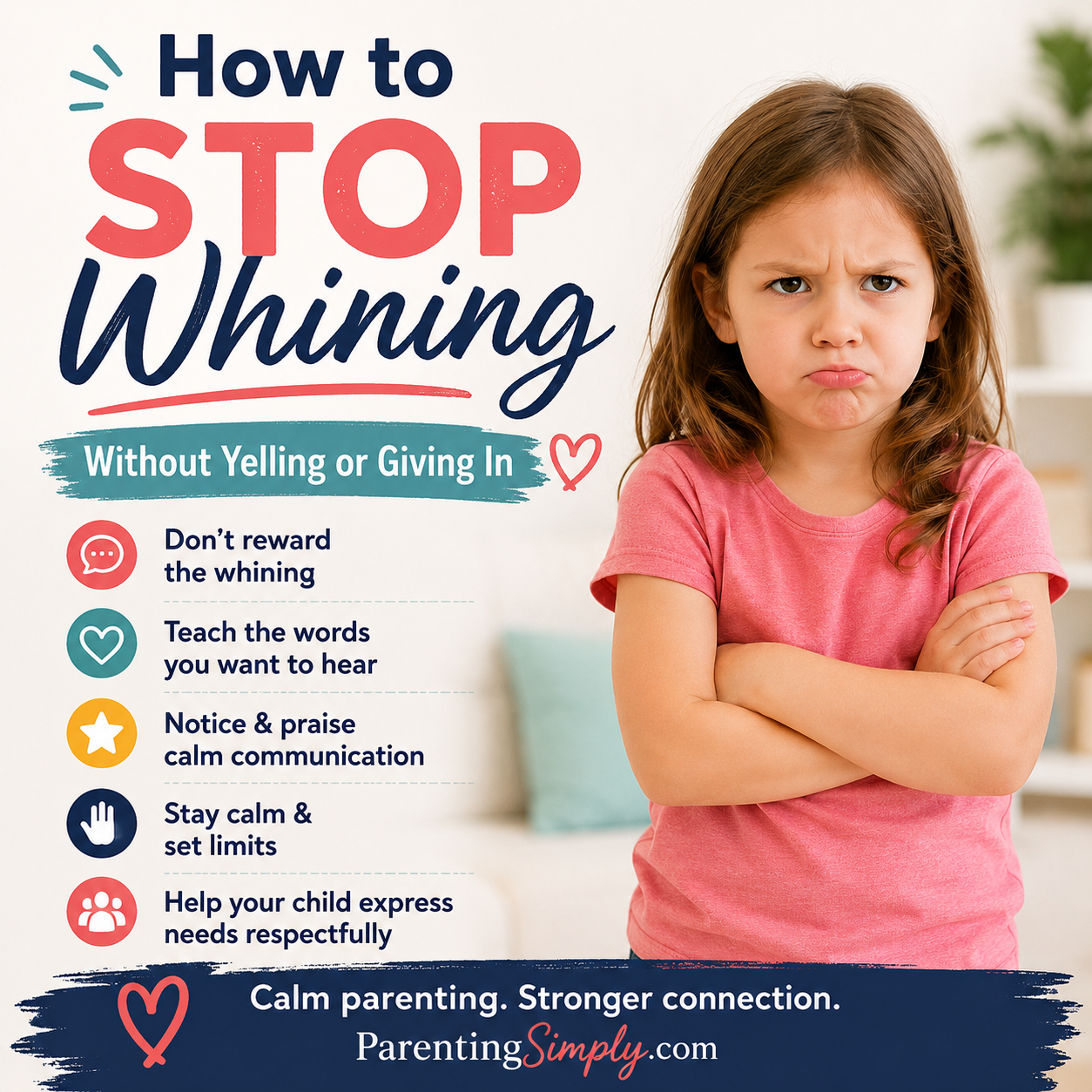
How to Stop Whining Without Yelling or Giving In
Whining can test even the most patient parent.
“Mommmmmmmm.”
“It’s not fair.”
“I want it now!”
After a long day, it’s easy to feel your stress level rise the minute that whiny voice appears.
Many parents respond by arguing, explaining, negotiating, or eventually giving in. Unfortunately, those responses often make whining stronger instead of weaker.
The good news is that there is a better way.
Why Children Whine
In many cases, children whine because it works.
Sometimes whining gets attention.
Sometimes it gets a parent to change their mind.
Sometimes it delays an unpleasant task.
And sometimes children simply do not know a better way to express disappointment, frustration, boredom, or an unmet need.
The good news is that whining is a learned behavior. That means it can also be unlearned.
What Parents Accidentally Do That Makes Whining Worse
Most parents do not encourage whining on purpose.
However, we sometimes accidentally reinforce it.
For example, a child may ask for a cookie before dinner.
You say no.
The whining begins.
You explain why dinner is soon.
Your child whines more.
You explain again.
Eventually, you give the cookie because you’re exhausted.
From your child’s perspective, the whining worked.
Even if you only give in occasionally, children learn that whining is worth trying.
As a result, the behavior often continues.
Don’t Reward the Whining
One of the biggest mistakes parents make is responding while the child is whining.
Instead of saying:
“Fine! Here! Take it!”
Try:
“I’ll be happy to listen when you use your regular voice.”
Then stop talking.
There is no need to lecture or argue.
Simply wait.
Once your child uses an appropriate tone of voice, respond warmly and respectfully.
Over time, children learn that respectful communication gets results. Whining does not.
Teach the Words You Want to Hear
Many children know what they don’t want.
However, they often struggle to express their feelings appropriately.
Instead of focusing only on stopping the whining, teach the language you want your child to use.
For example:
- “Can I please have a turn?”
- “I’m disappointed.”
- “Can you help me?”
- “I don’t like that.”
- “Can I have a turn when you’re finished?”
The more language children have, the less likely they are to rely on whining.
A Common Whining Scenario
Imagine your child wants a snack ten minutes before dinner.
“Pleeeeease.”
“I’m starving.”
“I want it now.”
Instead of arguing, explaining, or negotiating, you might calmly say:
“I’ll be happy to listen when you use your regular voice.”
Then stop talking.
When your child says:
“Can I please have a snack?”
You can respond respectfully:
“Dinner is in ten minutes. You may have a snack after dinner.”
Your answer may still be no, but your child learns that respectful communication is heard.
Catch Your Child Speaking Appropriately
One mistake parents make is paying attention only when children are whining.
Instead, try noticing the moments when they communicate appropriately.
You might say:
“I like how you asked so calmly.”
“Thank you for using your regular voice.”
“That was a very respectful way to ask.”
Children repeat the behaviors that receive attention.
The more we notice appropriate communication, the more likely we are to see it again.
Be Careful With Labels
Sometimes parents say things like:
“You’re such a whiner.”
“All you do is complain.”
The problem is that children often begin to believe the labels we give them.
Instead, try focusing on the behavior you want to encourage.
“I know you know how to ask in your regular voice.”
“I’ve heard you ask very respectfully before.”
“You know how to communicate your needs.”
When children begin to see themselves as capable communicators, they are more likely to act that way.
Stay Calm and Don’t Take the Bait
Whining often pulls parents into an emotional reaction.
The louder or more emotional the child becomes, the more tempted we are to engage.
However, the calmer you remain, the less rewarding whining becomes.
This does not mean ignoring your child.
It means refusing to participate in the whining dynamic.
Calm, confident responses are often much more effective than frustration or anger.
Remember: Whining Is a Skill Problem
Most children are not trying to drive their parents crazy.
Often, they simply have not learned a better way to express disappointment, frustration, boredom, or unmet needs.
When we teach children the words to use, model respectful communication, and consistently respond to appropriate behavior, whining gradually loses its purpose.
Like any skill, communication improves with practice.
Frequently Asked Questions About Whining
Why does my child whine so much?
Children often whine because it gets attention, delays tasks, or helps them get what they want. Some children also lack the language skills needed to express their feelings more effectively.
Should I ignore whining?
Rather than completely ignoring your child, try ignoring the whining while remaining available to listen when your child uses an appropriate tone of voice.
What age do children stop whining?
Whining is common in preschool and early elementary years. However, with consistent responses and good communication skills, it usually decreases over time.
Does punishment stop whining?
Punishment may stop the behavior temporarily, but teaching children better communication skills is often more effective in the long run.
Final Thoughts
The goal is not to raise children who never complain.
The goal is to help children learn how to express their needs, feelings, and frustrations respectfully.
When parents stay calm, avoid rewarding whining, teach better communication skills, and notice positive behavior, children gradually learn that respectful communication works much better than whining.
And that’s a lesson that will serve them long after childhood.