
Why Children Have Tantrums Over “Nothing” (And What Actually Helps)
One minute your child is sweet, cuddly, and cooperative. The next minute—boom—she’s yelling, crying, hiding under the table, or completely falling apart over something that seems incredibly small.
If your child has tantrums over nothing, you’re not alone.
Many young children have emotional outbursts that appear to come out of nowhere. Parents are often left thinking:
Why did that tiny thing cause such a huge reaction?
And how do I help without making it worse?
The reassuring news is that these emotional explosions are incredibly common—especially in sensitive children—and they usually have much more to do with overwhelm than bad behavior.
When children are still learning how to manage frustration, sensory overload, disappointment, hunger, tiredness, or sibling stress, even little things can suddenly feel enormous.
The good news? These moments can become opportunities to teach emotional regulation and resilience.
Look for Hidden Triggers Behind Tantrums
Sometimes children melt down over things that seem irrational to adults:
- Someone looked at them
- Their sibling sat too close
- Their toast broke
- They were asked to hurry
- Their sock feels “wrong”
But underneath those seemingly tiny triggers is often an overwhelmed nervous system.
Some children are simply more emotionally sensitive and reactive than others. According to Psychology Today, sensitive children often process experiences more intensely, which can lead to stronger emotional reactions.
Instead of focusing only on the behavior, become a detective and look for patterns.
Ask yourself:
- Does this happen more in the morning?
- During transitions?
- Around siblings?
- When my child is hungry or tired?
- When things feel rushed or overstimulating?
Once you notice patterns, you can often reduce stress before the tantrum begins.
For example:
- If mornings are hard, simplify routines.
- If sibling proximity causes friction, create more space.
- If transitions trigger meltdowns, give extra warnings beforehand.
Small adjustments can make a surprisingly big difference.
You may also enjoy:
Small Changes in Language, Big Changes in Cooperation
Why Children Have Tantrums Over Small Things
One of the hardest parts of parenting is accepting that emotional outbursts are a normal part of childhood.
Whining, crying, sulking, sibling conflict, and overreactions are not signs that you are failing as a parent. They are signs that your child is still developing emotional regulation skills.
Young children do not yet have mature coping mechanisms. Their brains are still learning how to tolerate frustration and calm themselves when emotions feel big.
According to The Child Mind Institute, children learn emotional regulation primarily through calm, connected interactions with adults.
That means your response matters more than the tantrum itself.
Instead of thinking:
“I need to stop this behavior immediately.”
Try reframing it as:
“My child is struggling with big feelings and needs help learning how to manage them.”
That shift changes everything.
Give Your Child Space to Regroup
If the crying or whining is escalating—and it’s becoming overwhelming for everyone—it’s okay to create calm boundaries.
You might say:
- “It seems like you need a quiet place to calm down.”
- “Would you like to go to your room yourself, or would you like me to walk with you?”
- “Do you want the bedroom or the bathroom to calm your body?”
This is not punishment.
You are simply helping your child move to a quieter environment where they can regulate more easily.
Some children calm down faster when they are away from siblings, noise, stimulation, or an audience.
And sometimes parents calm down faster too.
You may also like:
Want Kids to Listen Without Yelling?
Empathy Helps Children Calm Down Faster
Empathy is incredibly regulating for children.
When children feel understood, their nervous systems begin to settle. They feel safer, calmer, and less alone in their distress.
That does not mean you approve of screaming, whining, or rude behavior. It simply means you recognize that something feels hard for them right now.
Try statements like:
- “Something feels really upsetting.”
- “Sometimes little things suddenly feel very big.”
- “I wonder if everything feels overwhelming right now.”
- “You seem really uncomfortable inside.”
According to Harvard Center on the Developing Child, supportive adult relationships are one of the biggest factors in helping children develop self-regulation skills.
Children calm down faster when they feel emotionally safe.
Problem-Solve Later—Not During the Tantrum
Trying to reason with children in the middle of emotional overwhelm usually backfires.
During a tantrum, children are not in problem-solving mode. They are in survival mode.
Wait until everyone is calm before revisiting what happened.
Later, you might say:
- “What do you think made this morning feel so hard?”
- “Was there something bothering you before the crying started?”
- “Can you think of another way to handle those feelings next time?”
At this age, problem-solving is about planting seeds—not expecting perfection.
You are teaching your child:
- Feelings are okay
- Behavior still matters
- Big emotions can be managed
- Problems can be solved calmly
Notice the Moments Your Child Recovers
One encouraging sign is when children calm down and move on after an outburst.
That ability to recover matters.
Many children do not yet know how to prevent overwhelming emotions—but they are beginning to learn how to come back from them.
Notice those moments out loud:
- “You were really upset, but you calmed your body.”
- “You figured out how to feel better.”
- “That was hard, and you got through it.”
The more children hear positive feedback about emotional regulation, the more confident they become in their ability to manage themselves.
Final Thoughts on Tantrums Over Nothing
Tantrums over seemingly nothing can feel exhausting, confusing, and emotionally draining for parents. But often, those “little” triggers are not little to a sensitive or overwhelmed child.
When you respond with calmness, empathy, thoughtful boundaries, and curiosity instead of panic or anger, you help your child build emotional skills that will last a lifetime.
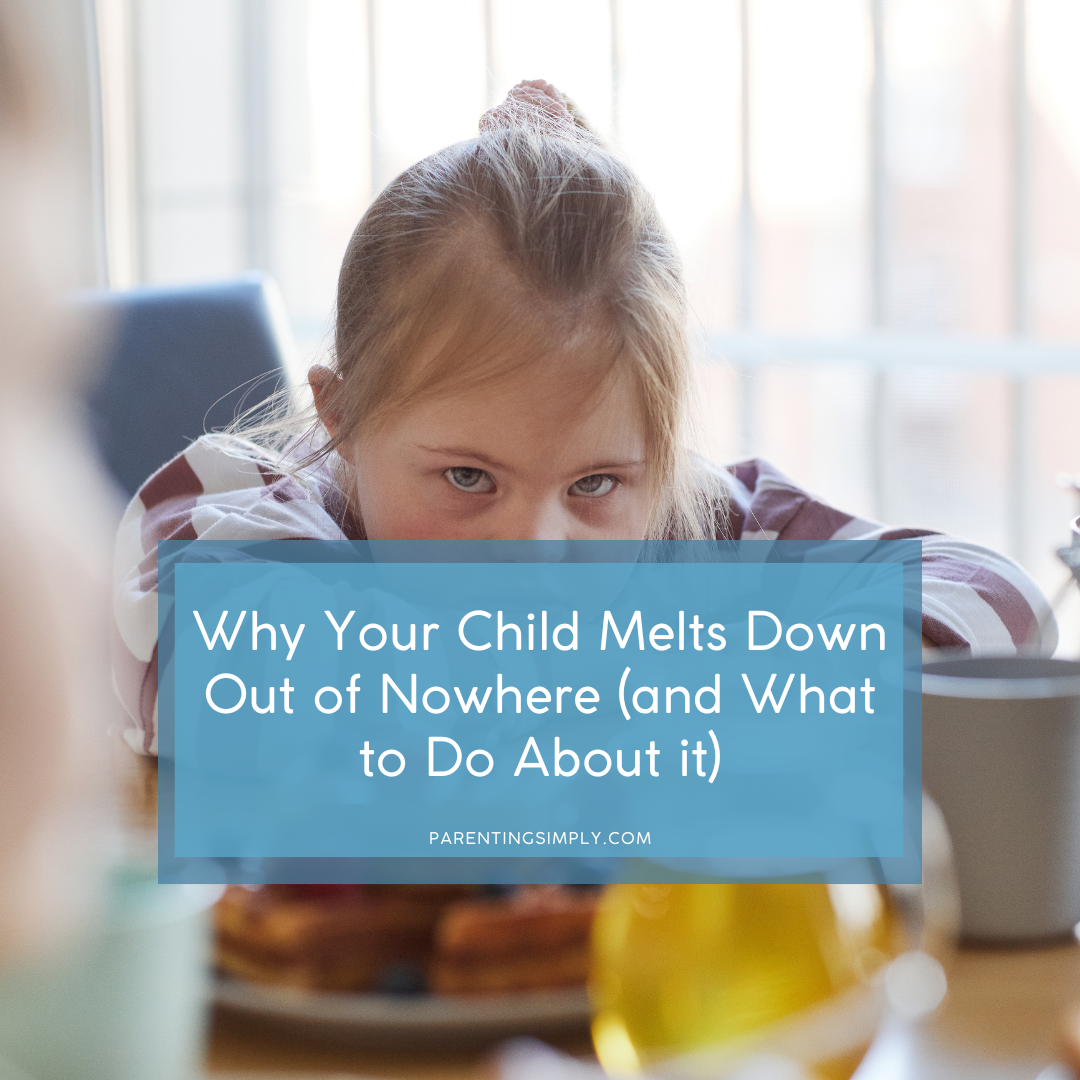
And sometimes that important learning happens right under the breakfast table.
You can learn more in my book, Parenting Simply: Preparing Kids for Life, filled with practical parenting tools you can use right away.
Or, if you are looking for step-by-step guidance to become a calmer, more confident parent, check out my online course, Simple Ways to Parent Without Anger.
Did you hear? I have a new podcast! Simply Jewish Parenting. Subscribe here!