

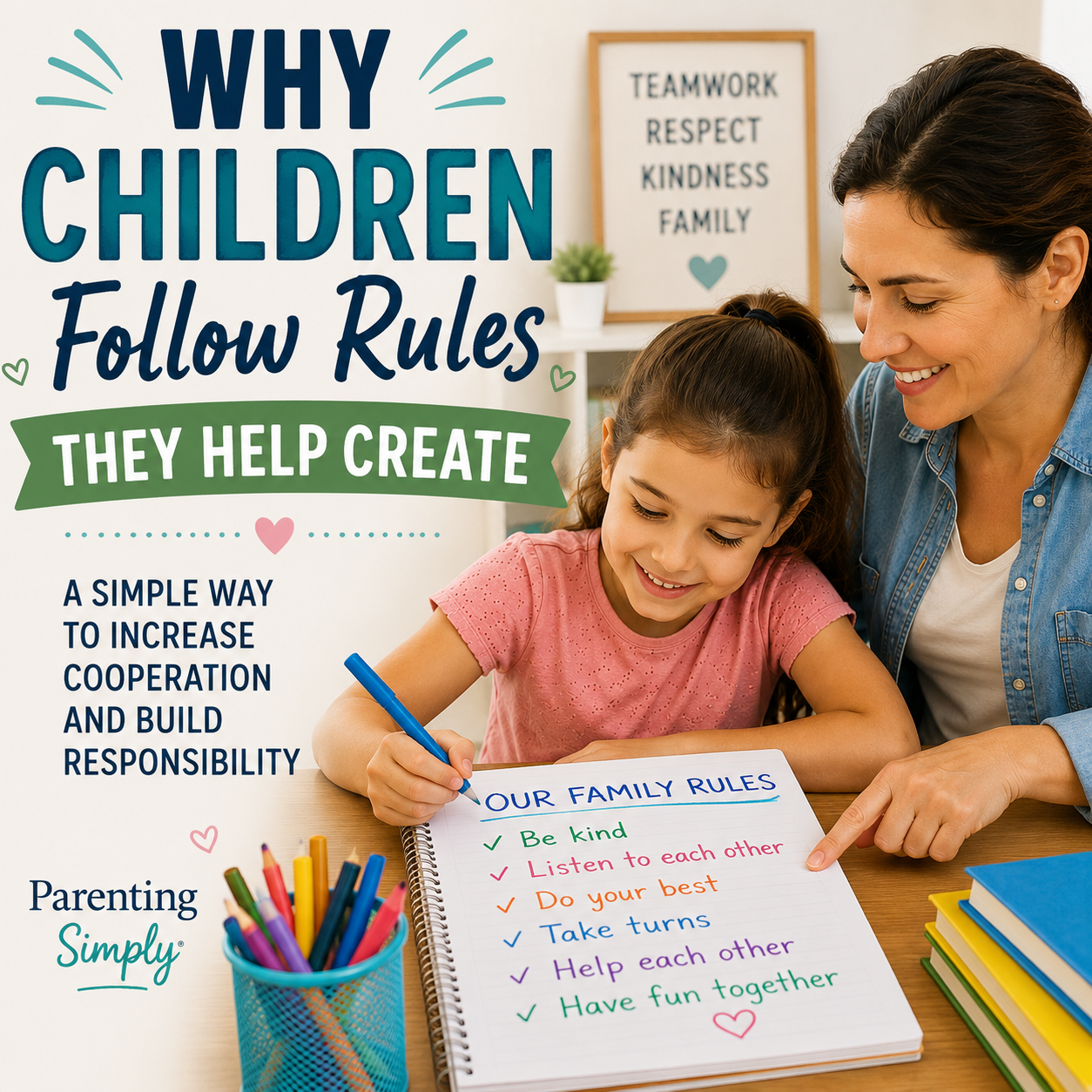
Family Rules for Kids: Why Children Follow Rules They Help Create
Family rules for kids can either become a source of daily conflict or a tool for building cooperation and responsibility.
Many parents assume their job is to create the rules and their children’s job is to follow them. But one of the simplest ways to increase cooperation is to involve children in solving the problems that affect them.
When children help create solutions, they often become much more invested in following them. As a result, family rules for kids become easier to enforce, and power struggles often decrease.
Why Family Rules for Kids Sometimes Fail
Most children do not enjoy being told what to do. The more a rule feels imposed on them, the more likely they are to resist it.
That does not mean children should run the household. Parents still provide leadership, guidance, and boundaries. However, when children are given a chance to participate in solving everyday problems, they are often far more willing to follow the plan.
Children are much more likely to cooperate with a rule they helped create than one that simply feels forced on them.
The Homework Problem
Imagine your child forgets homework every week.
Many parents respond by reminding, lecturing, and reminding again. Eventually, the parent becomes frustrated, and the child becomes annoyed. Nobody feels successful.
Instead, try saying:
“We seem to have a homework problem. What ideas do you have?”
Your child might suggest:
- putting homework in the backpack immediately after finishing it
- creating a checklist
- setting an alarm
- keeping a folder by the door
Will every idea work perfectly? No. But children are often much more likely to follow through on a solution they helped create.
Children Need Ownership
Parents often assume cooperation comes from control. In reality, cooperation often comes from ownership.
When children feel like something is their plan, they work harder to make it successful. That does not mean they are in charge. It simply means they are involved.
That is a big difference.
Children who participate in solving problems learn that their ideas matter and that they can contribute to family life in meaningful ways.
What This Might Sound Like in Real Life
Let’s say your child leaves school papers scattered all over the kitchen table every afternoon.
You could say:
“How many times do I have to tell you to put your papers away?”
Or you could say:
“We seem to have a paper problem. What do you think would help?”
Your child might suggest:
- a folder by the door
- a basket for papers
- putting papers directly into a backpack
Will the solution work perfectly? Maybe. Maybe not.
But now your child is helping solve the problem instead of simply being reminded about it. That small shift often leads to greater cooperation.
Using Family Meetings to Create Family Rules for Kids
You do not need a formal family meeting every week. Sometimes a five-minute conversation is enough.
Try asking:
- What is one thing we could do to make mornings easier?
- What is one thing we could do to make bedtime smoother?
- What would help our family argue less?
- What would make cleanup easier?
Children often come up with solutions adults never would have considered. And even when their ideas are imperfect, the conversation itself builds responsibility and problem-solving skills.
Family Rules for Kids During the School Year
The beginning of the school year often brings a flood of new routines and responsibilities. Children need to remember homework, pack backpacks, put away papers, complete chores, and get ready for school on time.
Parents can quickly fall into the role of reminder-in-chief:
- “Did you pack your folder?”
- “Did you finish your homework?”
- “Did you put your sneakers in your backpack?”
Instead of taking full responsibility for every task, involve your child in creating a system.
You might ask:
- What would help you remember your homework?
- What should we do with papers when you get home?
- What would help mornings run more smoothly?
When children help create the plan, they are much more likely to take ownership of it.
The goal is not to raise children who rely on constant reminders. The goal is to raise children who learn how to manage responsibilities independently.
What If Your Child’s Idea Isn’t Good?
Sometimes children suggest solutions that are unrealistic.
For example:
- “What if I never have homework again?”
- “What if I don’t have to clean my room?”
Instead of immediately dismissing the idea, stay curious. You might say:
“That’s an interesting idea. Can you think of another solution that would work for everyone?”
This keeps the conversation collaborative while still maintaining reasonable limits.
Remember, the goal is not to accept every suggestion. The goal is to teach problem-solving.
Don’t Use This Tool for Everything
One mistake parents make is trying to negotiate every decision.
Some rules are simply not open for discussion. Safety, health, school attendance, respect, and family values are parent decisions. Children can certainly share their feelings about those rules, but they do not get the final vote.
When Parents Need to Make the Rule
Inviting children into problem-solving does not mean every decision becomes a family vote. There are times when parents need to make the rule themselves.
For example:
- wearing a seatbelt
- holding hands in a parking lot
- taking medication
- following family safety rules
- going to school
- following important family values
Sometimes I tell children:
“Daddy and I like it when we all create rules for our family. Nevertheless, sometimes Daddy and I need to make the rule by ourselves. This is one of those times.”
Children usually understand this explanation. They learn that while their opinions matter, parents are still responsible for keeping everyone safe and helping the family run smoothly.
Family Rules for Kids That Children Can Help Create
Children often do a wonderful job helping solve everyday family problems.
For example, if bedtime is becoming difficult, you might ask:
“What do you think would help bedtime go more smoothly?”
A child might suggest:
- choosing pajamas before bedtime
- reading one story instead of two
- setting a timer before cleanup
- packing a favorite stuffed animal before bed
If siblings are arguing over toys, you might ask:
“What would be a fair way to solve this problem?”
Children often suggest:
- taking turns
- using a timer
- alternating days
- creating a schedule
When children help create the solution, they are usually much more willing to follow it.
Teaching Responsibility Through Problem-Solving
Inviting children into problem-solving teaches much more than cooperation. It also teaches:
- responsibility
- decision-making
- perspective-taking
- flexibility
- accountability
- problem-solving
These are life skills children will use far beyond childhood.
When children participate in creating solutions, they learn that they are capable of handling challenges and contributing to family life.
Children Support What They Help Create
One of the reasons family rules for kids work so well is simple: children support what they help create.
When a child helps develop a homework system, a chore routine, or a solution to a sibling conflict, the plan no longer belongs only to the parent. It belongs to them, too.
That sense of ownership often leads to greater cooperation, fewer reminders, and less conflict at home.
Family rules for kids are not about giving children control over the household. They are about helping children become active participants in family life.
Final Thoughts
Parents do not need to solve every problem for their children. In fact, sometimes the best solution is asking one simple question:
“What do you think would help?”
You may be surprised by the answer.
Children are often more thoughtful, creative, and practical than we expect. And sometimes, the best way to help children follow a rule is to let them help create it.
FAQ About Family Rules for Kids
Why should children help create family rules?
Children are often more invested in following rules when they help create them. Participating in problem-solving increases ownership, responsibility, and cooperation.
Does letting children help create rules mean they are in charge?
No. Parents remain the leaders of the family. Children can contribute ideas, but parents make the final decisions, especially around safety and family values.
What kinds of family rules can children help create?
Children can often help create routines for homework, chores, bedtime, morning routines, screen time, and sibling conflicts.
What rules should parents make themselves?
Parents should make rules related to safety, health, respect, family values, and other non-negotiable responsibilities.
FAQ Section
Why should children help create family rules?
Children are often more invested in following rules when they help create them. Participating in problem-solving increases ownership and cooperation.
Does letting children help create rules mean they are in charge?
No. Parents remain the leaders of the family. Children can contribute ideas, but parents make the final decisions, especially regarding safety and family values.
What kinds of family rules can children help create?
Children can help create routines for homework, chores, bedtime, morning routines, screen time, and sibling conflicts.
What rules should parents make themselves?
Parents should make rules related to safety, health, respect, family values, and other non-negotiable responsibilities.
Want to learn more?
👉Why Saying “You Have a Choice” Can Reduce Power Struggles Almost Instantly